A place for the gods.
Four shrines become towering landmarks: ancestral roots, a beating heart, a captive storm and a broken mirror.
The god picker already gives each patron a strong architectural identity. This pass carries those designs into the battlefield at a much larger scale, then gives each shrine a distinct rhythm and response to the souls arriving at its circle.
Sacred architecture above the fight.
The structures stand eleven metres tall, roughly twice the previous altars. Their shallow bases sit behind the existing three-metre circle, leaving its centre and approach open. The world label is lower and smaller so the action point stays useful nearby.
Sacrifice’s gameplay shrines informed the composition: an overhead silhouette, separated supports and a clear ritual forecourt. Eleven metres is our own design choice, rather than a measurement recovered from its screenshots. Terrain, navigation and collision remain unchanged.
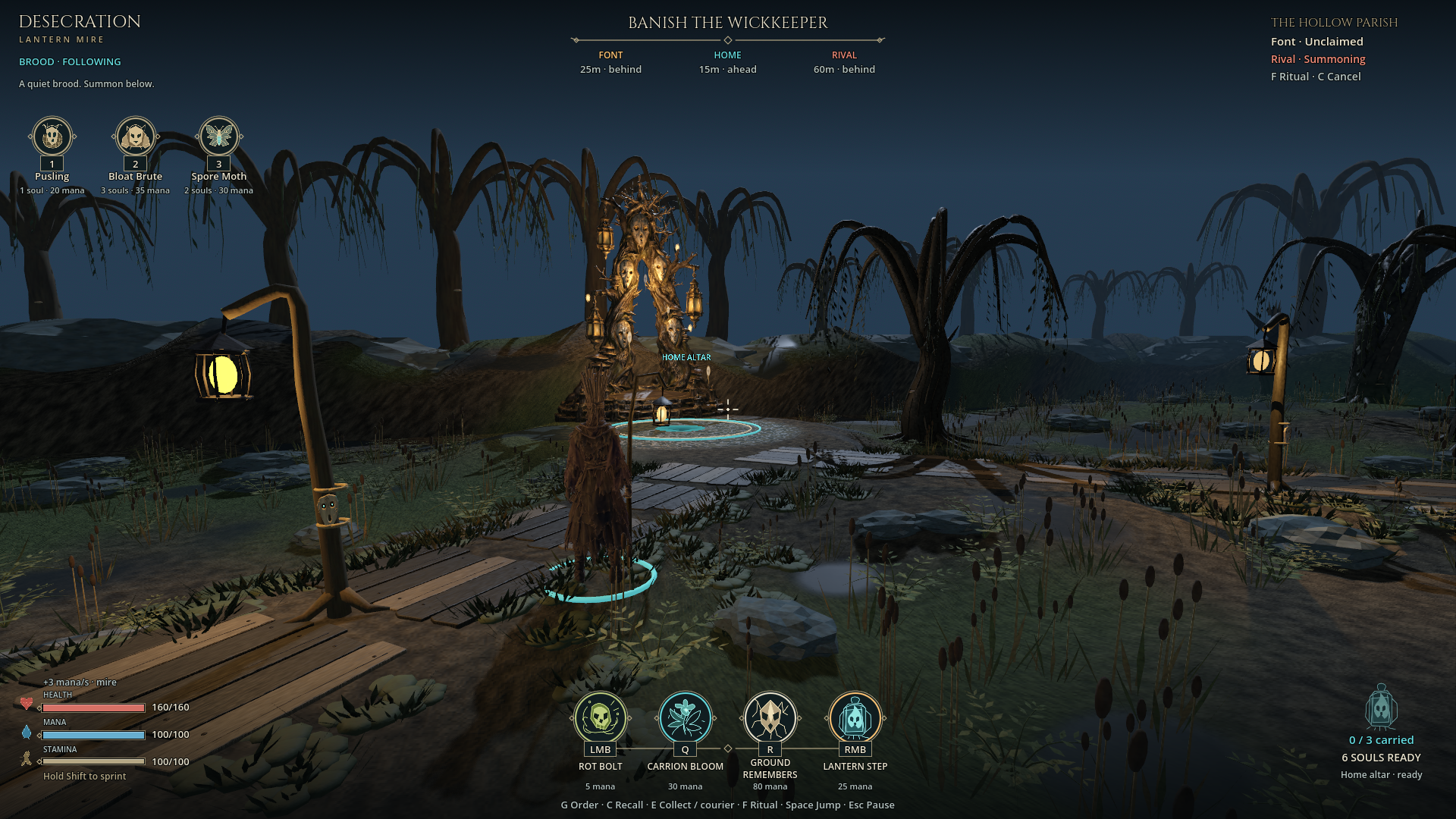
Vessara: the ancestors gather.
The root cathedral carries five carved masks and three warm lanterns. Masked spirits drift upward from the forecourt, and the lantern light breathes gently. Purification gathers a stronger procession; idle returns to a handful of souls.
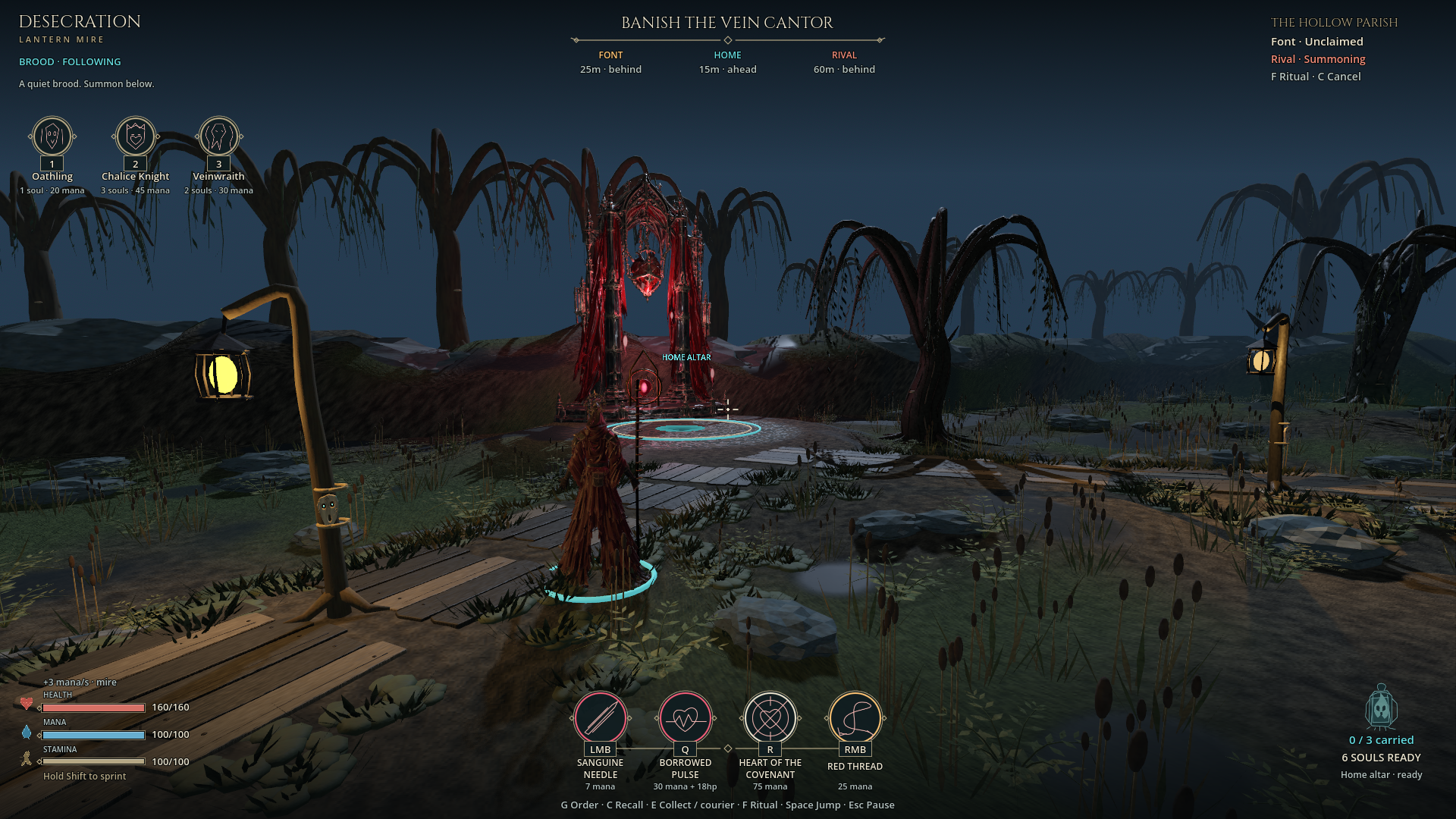
Ilveth: a heart under oath.
The iron reliquary holds a large anatomical heart among hanging red cloth. A localized double beat moves the heart while the building stays still. Red light and devotional soul shapes carry the same identity as the original god-picker shrine.
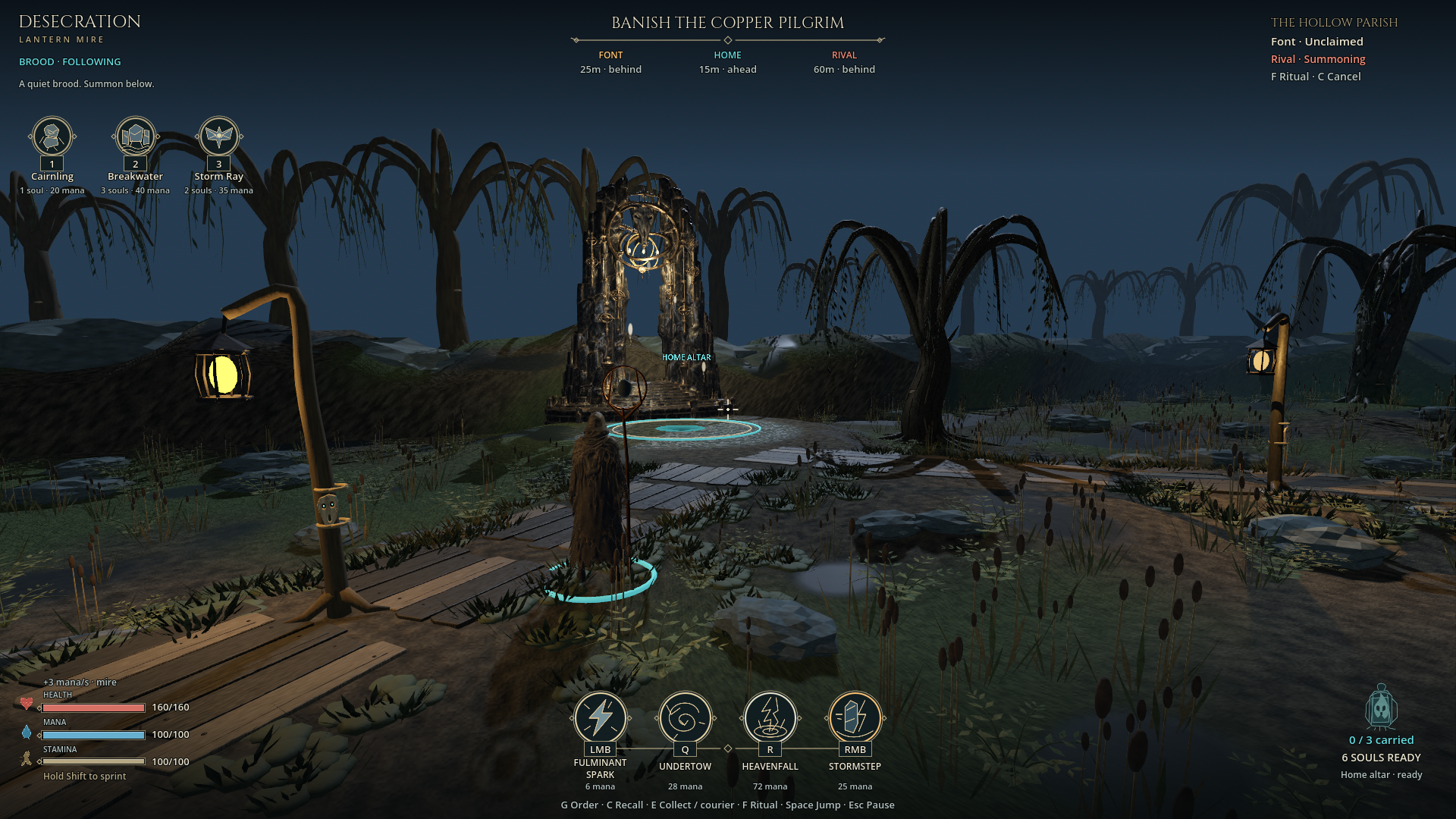
Veyra: a contained storm.
Tall stone columns frame brass rings and a pale central focus. Two smaller rings turn in opposing directions, while intermittent lightning stays inside the shrine. Rising storm souls intensify during purification without washing out the combat boundary.
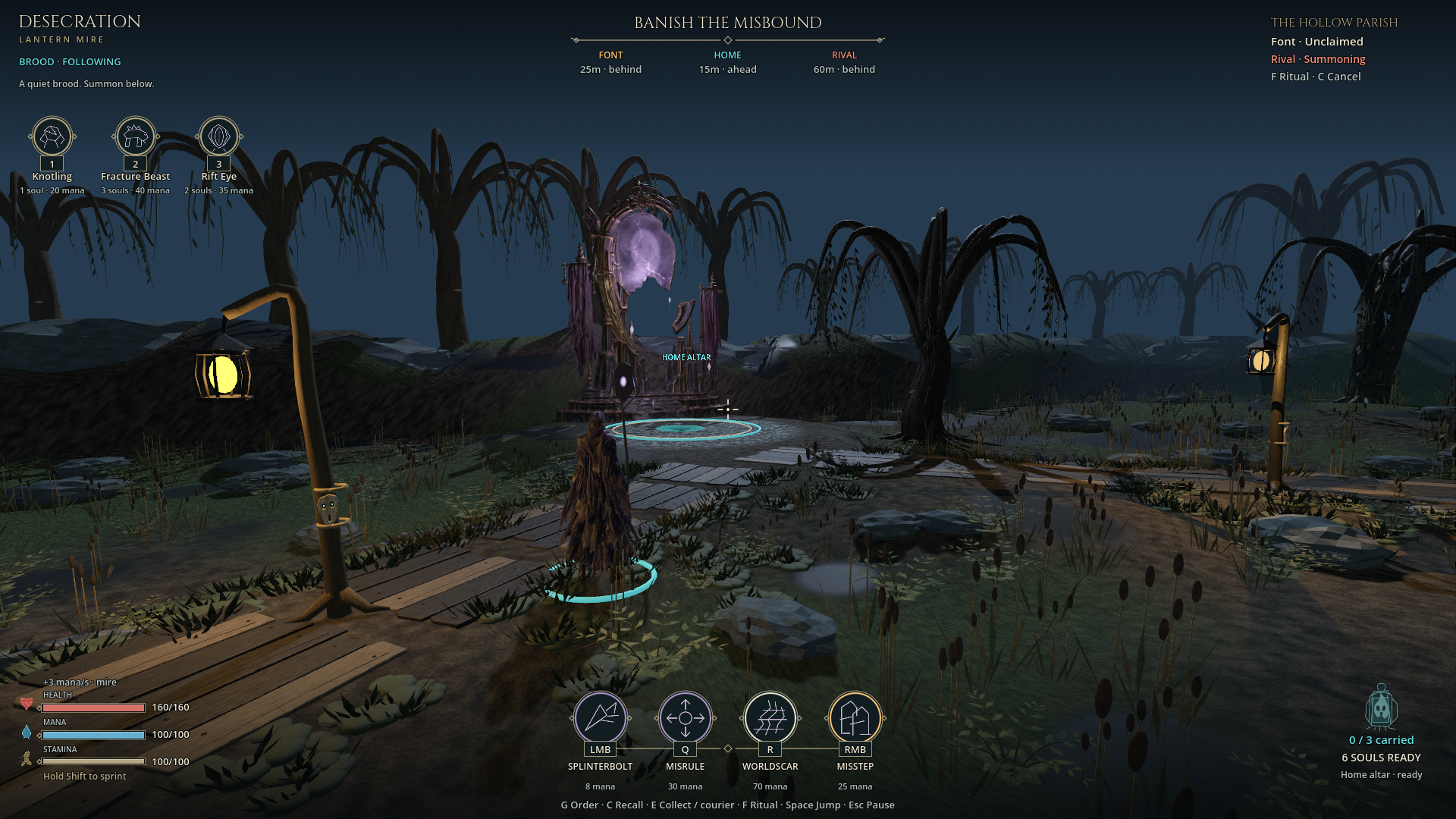
Vorr: the reflection will not settle.
Suspended mirror pendants drift slowly around a fractured frame. A violet apparition shifts across the mirror and the souls take folding paths toward it. This is a small procedural surface effect; it does not need a copy of the whole screen for reflections.
What each tool contributed.
Higgsfield GPT Image 2.5 made four isolated references from the original picker paintings. The batch reached observed completion in about one minute. Meshy 7 Ultra produced the textured structures in roughly three to six minutes per model, with jobs overlapping.
Local Blender handled welding, duplicate-face repair, scale, the shallow footprint, movable mirror pieces, heartbeat deformation and attachment points. Each cleaned model has fewer than 45,000 triangles and three compressed, mipmapped 2K textures. Godot owns all interactive lighting, soul paths and state changes. This iteration did not use 3D Jutsu or Astra.
Meshy reports 140 credits consumed, or 35 per altar. Higgsfield quoted 12 credits for the four references; its displayed balance did not change, so the final debit is unverified. Local Blender used no generation credits. Building and tuning the preparation recipe took much longer than rerunning its sub-second geometry steps.
The same soul must still be earned.
Five decorative souls idle; the active procession is capped at sixteen in one fixed batch per altar. Those shapes never enter the gameplay soul account. The three-second purification and twelve-second sacrifice remain unchanged.
The guest previously interpreted purification progress through the ritual’s longer clock. The snapshot adapter now uses the correct duration for each state. Interruption remains coral; banishment extinguishes the effects immediately. Reduced motion freezes decorative travel.
The cost of a landmark.
Four matched one-minute runs put both Vessara altars behind a sixteen-unit paid battle and hold both shrines active. Each run completes the same 118 bolts and fourteen area spells. At 1920 × 1080 on this M5, the previous pack averages 41.13 ms per frame and the new pack 40.83 ms. That small difference is not a dependable frame-rate improvement.
The new samples use about 74 MiB less reported graphics memory. The four-model pack grows by about 67 MiB on disk, so download size and live memory move in different directions. Fresh-process match preparation takes about 2.5–3.0 seconds in these runs, with existing driver caches retained.
This deliberately dense view still runs around 24 frames per second. It is useful for comparing the altar change, but broader busy-scene performance remains unfinished. The test covers a Vessara pair on one Mac; it does not certify every faction pairing or another device.
Ready for a closer playtest.
The exact app passes 678 packaged-asset checks and 198 focused native checks covering scale, compressed textures, clear ritual space, finite effects, reduced motion, banishment, guest progress and retained art. The four captures each complete one actual soul purification.
Two local native multiplayer windows pass 62 further assertions across all four faction matches, including the host-selected altar identities. This exercises real local networking; it is not a two-device internet test.
Earlier native source checks cover courier delivery, ritual interruption, sacrifice and restart. Two older long-running rival/match suites exceeded a four-minute limit and are retained as incomplete runs. Their partial output is not counted as a pass.
A separate Mac playtest app preserves the earlier build and the main checkout. Both multiplayer players need the new app. Hands-on combat readability, another physical device and Intel performance still need playtesting.