Roots beside the water.
Gnarled willows, fallen wood and layered slate now frame the mana font. Worn boards, damp ground and a quieter capture marker bring the new props into the playable mire.
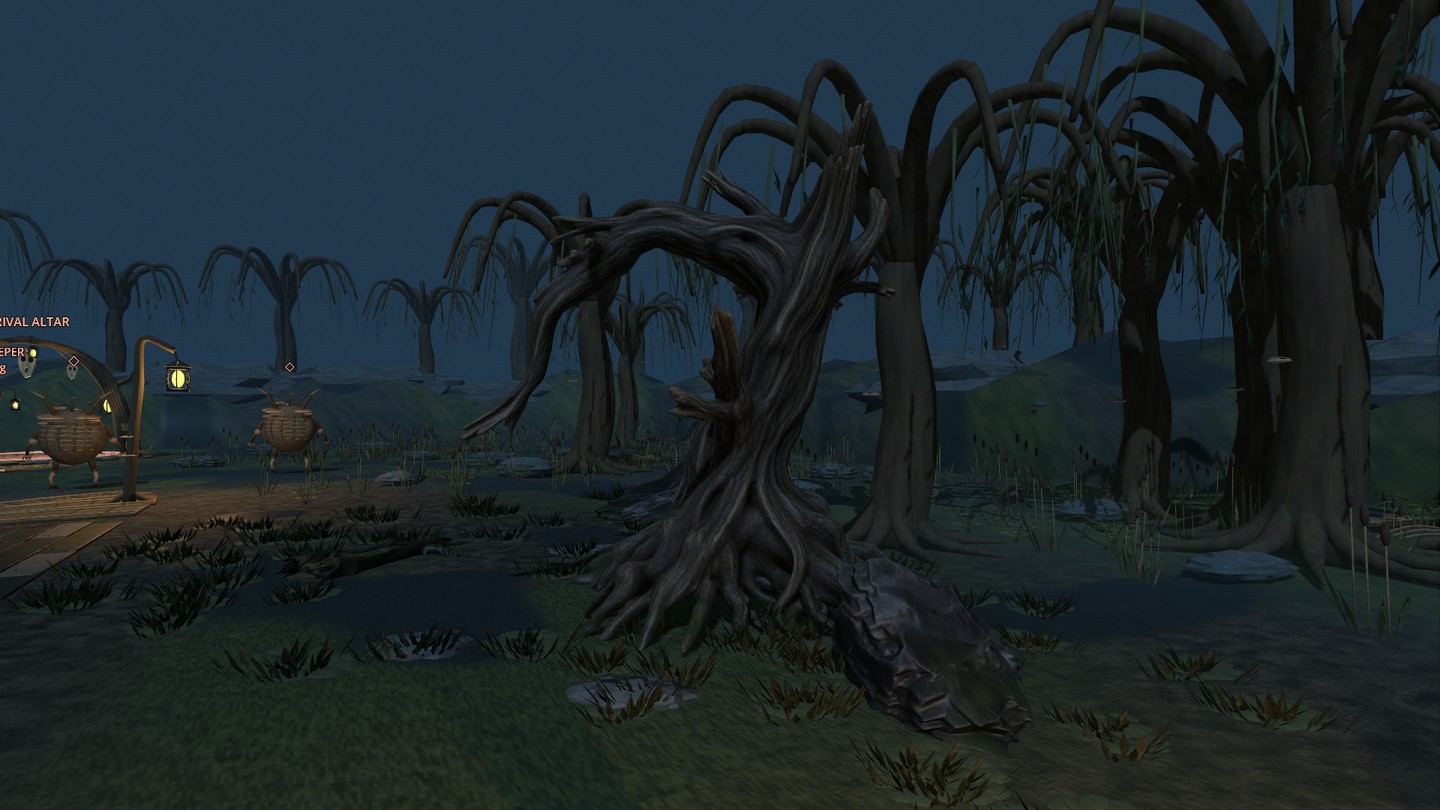
Shaun returned from Meshy with three textured models based on our image briefs: a twisted stump, weathered driftwood and a slate outcrop. We used them together on one stretch of the font approach, where their silhouettes and grain can be judged at the real play camera.
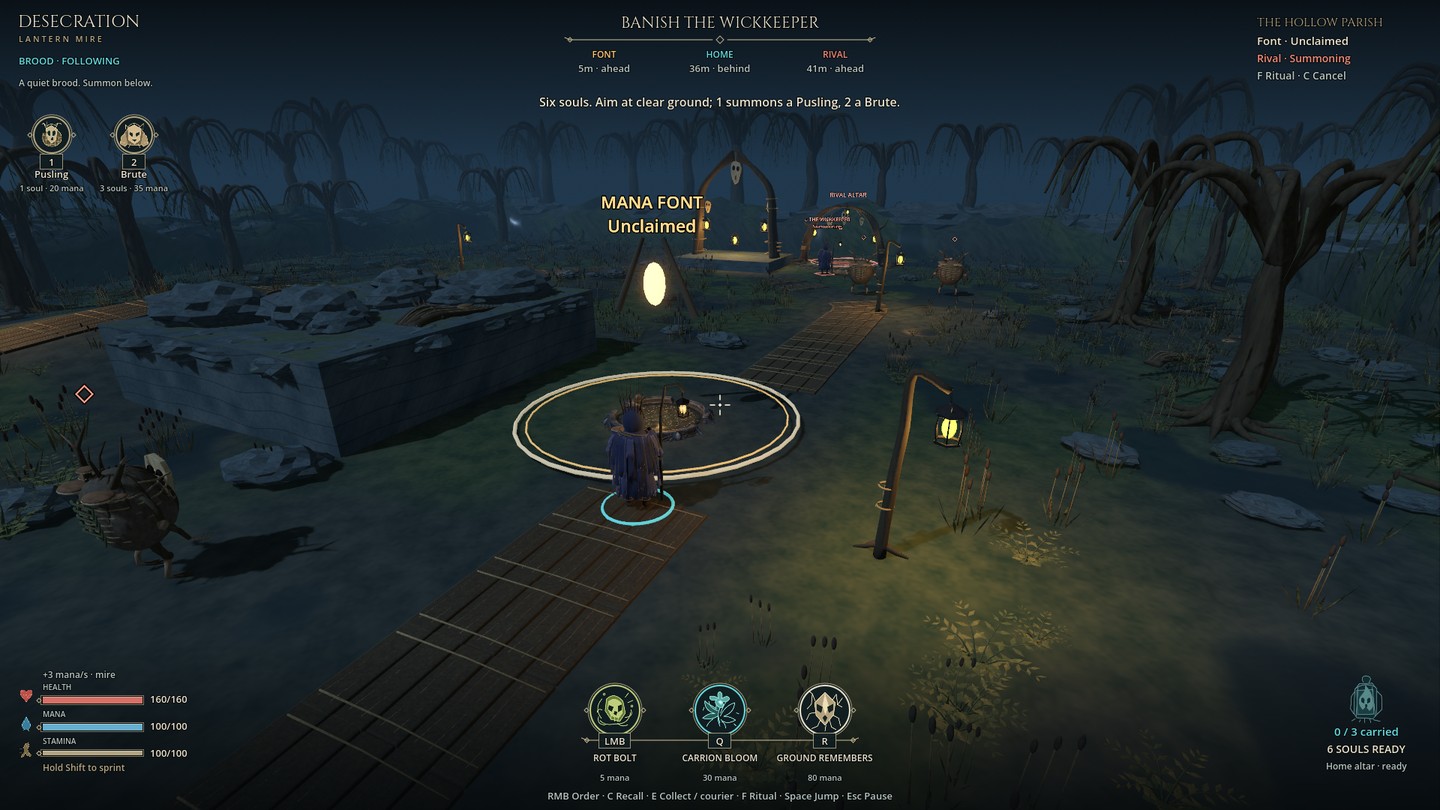
The same place, before
The earlier build already had the stone font, but its tall beacon, bright double ring and evenly scattered plants dominated this approach. We kept the playable layout and concentrated the work around the path and outer bank.
The new dressing uses two willows, two logs and four slate pieces. Their roots and bulk stay outside the capture disc and broad causeway. Existing local study plants and boards are replaced with our original worn-board and clumped-sedge kit.
Keep the grain
Codex inspected the front, back and underside of each supplied mesh, then prepared it in Blender. The willow went from 278,504 to 24,000 triangles, the log from 50,818 to 9,000, and the slate from 119,280 to 10,000.
New texture layouts and reprojection preserve colour, surface normals and roughness. Each prepared model has one material and three 2K maps. The original downloads and editable high-detail sources are retained. Godot adds restrained wetness and moss near the base so the objects meet the surrounding peat.
The model generation is Shaun’s Meshy work. Blender preparation and game integration are Codex’s, while our existing original kit supplies boards, vegetation and lanterns. The service’s generation-specific settings and plan remain unconfirmed; Meshy credit is retained.
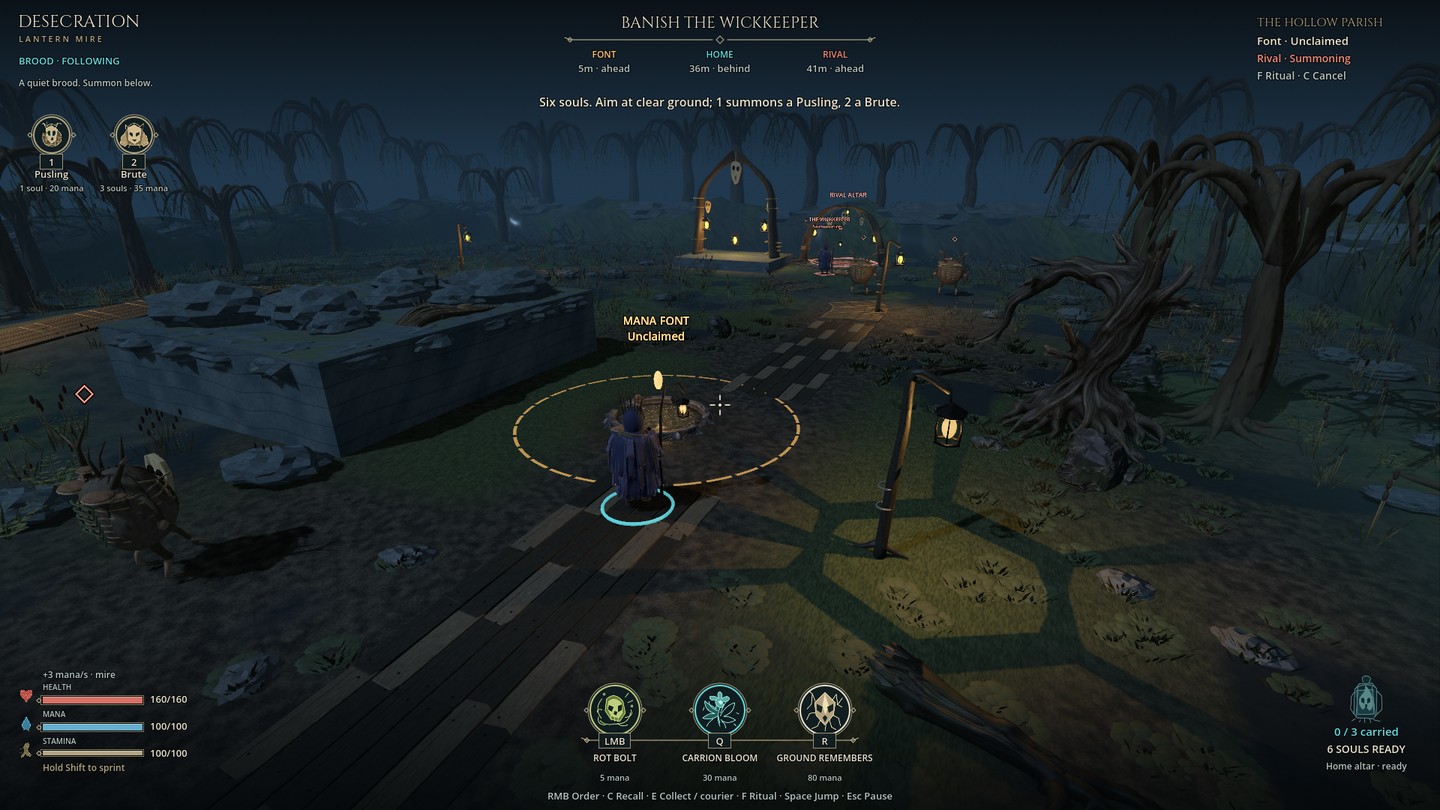
Let the place read
The font now carries a smaller beacon and a thin broken circle that follows the ground. Its arc fills from the actual capture clock. Ownership colours and explicit text still explain yours, the rival’s and contested states; the four-metre boundary is unchanged.
Worn boards lead through darker, textured peat. One existing wayside lantern casts shadows, and the outer bank gets a little more of the existing low mist. These are local changes: the nearby fight, paths and status markers remain readable.
The complete duel is preserved. Capture still takes four uninterrupted seconds, the owned font restores eight mana per second within eight metres, and opposing living units still contest it. Collision, navigation, eighteen souls, jump, stamina sprint, trackpad zoom and remapping retain their rules.
Checked and ready to walk
The game passed 849 regression assertions and fourteen audio-file checks. The actual export passed 165 asset checks, 22 font checks and 25 approach checks. Ten final captures were inspected. Computer use checked the standalone app, settings, paid summoning, scroll, Bloom, restart and pause; native fixtures verified precise capture states and passage.
Two short 1080p crowd samples per build measured the new build’s 95th-percentile frame interval at 12.9 and 12.6 milliseconds, against 10.8 and 11.0 before. The first new-build sample had fifteen frames above 33.3 milliseconds; a reversed-order repeat had one, while the old build had zero then five. All samples are retained. The cause of the first burst is unresolved, and these brief checks do not establish sustained performance.
The new Mac build and complete predecessor are saved, and the delivered game has been opened, restarted and left paused for Shaun. Subjective art and combat judgement, physical Intel and Windows testing remain outstanding.
This is a useful step for the font approach. Repeated background trees, the central cover and character surfaces still show the gap to the concept. The next useful local pass would address that visible central cover and its ground joins using the existing kit, before commissioning more meshes.