The ghost from the sketch.
The opening guide now uses a full 3D hooded apparition based on the supplied white ghost reference, with an empty face, flowing sleeves and fading trails.
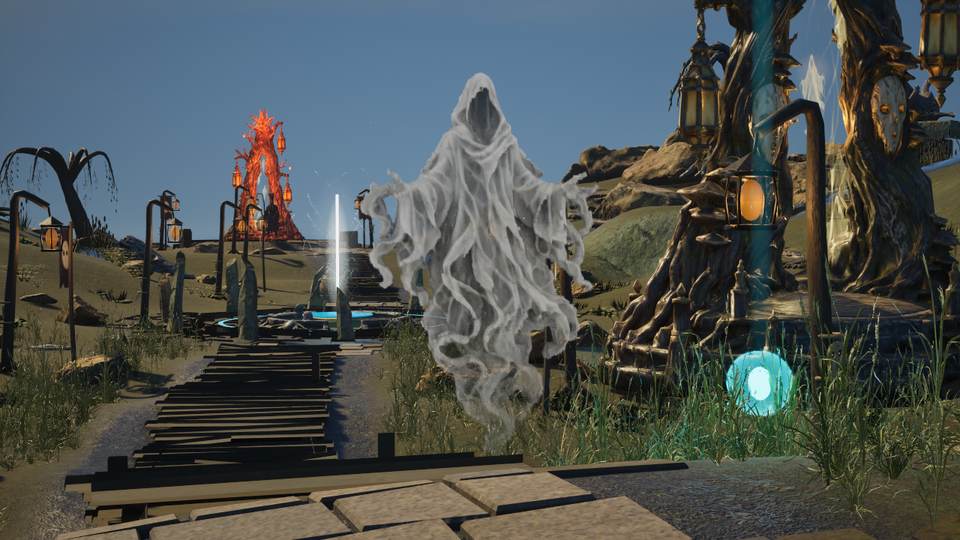
The guide was wearing the wrong body. A material trial on the Wizard could change its glow, but the intended character was the hooded white ghost from the artwork. The new opening guide follows that silhouette in three dimensions.
From image to body
One approved Meshy image-to-3D generation produced the hood, open sleeves and winding lower robe. It consumed 30 credits. Front, side and back renders checked the generated body before local Blender processing reduced approximately 2.9 million triangles to 90,000; the original model is preserved.
The image’s wisps become a combination of geometry and a dedicated Unreal material. A locally baked shading map keeps the empty hood and cloth folds readable, while a slow shader hover and softer lower trails give the static mesh motion. There is no skeletal rig or cloth simulation in this pass.
Read it in the world
The first transparent material washed out the hood. Actual campaign captures exposed that problem, and the revised surface preserves darker cavities. Front and back views also caught the imported facing direction before the separate playtest was packaged. Epic Unreal MCP inspected the mesh assignment and material settings during this work.
The guide keeps its existing dialogue, visibility changes and tutorial placement. The shared spirit material, altar portal artwork, combat rules and finale character remain as before.
Check the delivered app
The separate Mac app passes 1,300 gameplay assertions and six guide-specific checks, including hiding, revealing, tutorial repositioning and separation from collision and combat units. Its front, side, back, normal-camera and dialogue captures are retained alongside a six-second moving-camera sequence.
This establishes the intended character in the opening campaign. Human judgment of its brightness, scale and motion remains the next art checkpoint. The model uses a local reduction and simple shader movement; it is not a finished cinematic character, and these captures do not establish a performance improvement.