The ground wakes.
The detailed willow joins the multiplayer game, and Ground Remembers becomes an uneven eruption of roots, fleeting ancestors and falling peat.
The earlier environment study lived in a separate comparison build. Its willow, ground contact and restrained lighting are now brought onto the current multiplayer and performance foundation. The next visual slice stays focused on one spell: giving Ground Remembers a clearer build-up, stronger silhouette and quieter aftermath.
Finish one bank first.
The prepared tree replaces one font-side willow. Nine low stones and local moss and peat shading connect its roots to the ground. A modest change to moonlight, ambient light and lantern strength lets the silhouette read against the mist.
The original terrain, collision, navigation and combat routes remain intact. This is a local environment pass; the rest of the scenery still needs the same care. The selected Lantern Mire painting remains the direction for that work.
The willow reuses the existing Astra-in-3D-Jutsu and Meshy work: one surface and 23,900 triangles. No new generation jobs or credits were used. Higgsfield provides reference and motion studies; Meshy provides selected solid forms; Godot controls the interactive lighting, timing and particles.
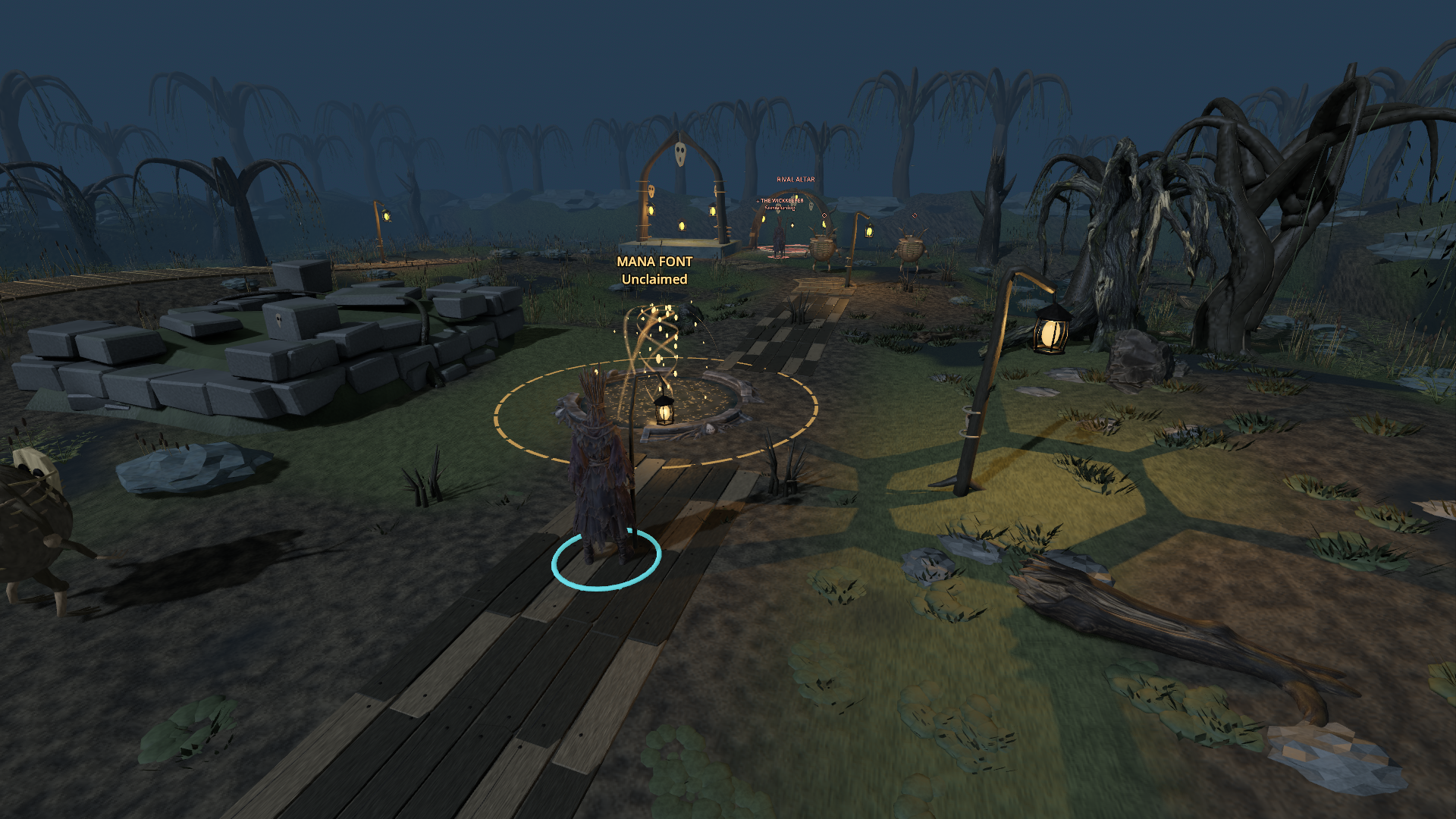
The previous eruption.
The earlier spell already had the right ingredients: a warning ring, glowing roots, ancestor traces and a retained scar. Its roots rose with a fairly uniform height and rhythm. The goal here was to make the event feel less orderly without hiding where it will hit.
Pressure, fracture, release.
Fissures now spread during the warning. Seven roots break through at different heights and angles, with a staggered rise and brief recoil. Narrow flame ribbons leave more space between the shapes. The ancestor faces appear briefly, their lower forms dissolving into the light.
The first revision made those spirits too solid and bright. Native captures led to a shorter, more translucent treatment. A quick local light flash, falling peat and low ash give the eruption an impact and a finish. The warning and impact sounds add synthesized wood strain, fractures and a short voiced resonance.
The spell keeps its original 1.25-second warning, six-metre boundary, mana cost, cooldown, damage and slow. The temporary population is still seven roots, three spirits, 112 embers, 40 char fragments, 14 ash clouds and one unshadowed light. The retained scar stays quiet.
The edge stays readable.
The roots and ancestor forms rise inside the six-metre combat boundary. The original cyan and coral allegiance colours, together with their different shape cues, remain in place. The warning lasts 1.25 seconds and the eruption one second; the extra drama does not move the hit or extend its reach.
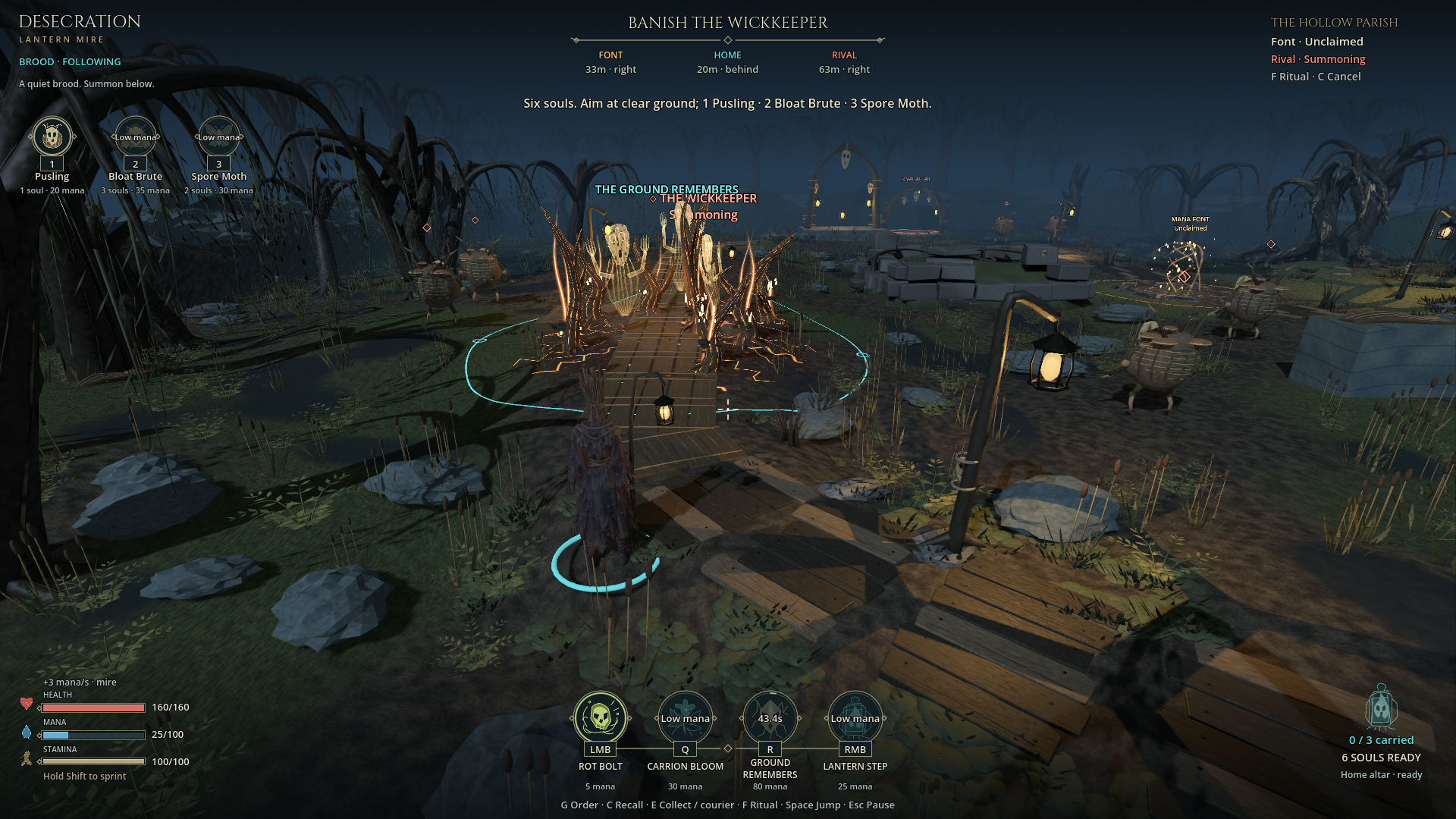
The aftermath must end for both players.
Testing found a guest-side bug: when the host finished an eruption, the guest kept its temporary lights and particle nodes alongside the scar. The snapshot adapter now retires that presentation at the host’s scar state. It does not run damage or change the host’s scar retention rules.
Two native local windows completed four faction rounds, including a real Ground eruption observed and then cleaned up on the guest. Separate checks cover paid opposing casts, one-time damage, pause, slope contact, cover and restart. This is local multiplayer evidence, not a second-device or internet playtest.
A measured step toward the painting.
Four matched one-minute combat samples compared the current performance build with the integrated environment. Each ran sixteen paid creatures, 120 bolts and fourteen area spells. The environment averaged about 0.2 milliseconds more per frame on this Apple M5. The earlier comparison’s much larger slowdown did not recur.
A separate four-run comparison held the new environment constant and repeated forty major spells per minute, with two active at once. All four runs completed the same workload. The refined spell averaged 14.34 ms per frame against 14.13 ms for the previous spell: about 0.21 ms more on this Mac. Occasional long frames remained in both versions; GPU timing counters were unavailable, and this is not a general frame-rate guarantee.
The visual result remains one step toward the painting. Other landmarks and character presentation need separate iterations. Human play and listening still need to judge the spell’s drama, clarity and mix.