The path takes root.
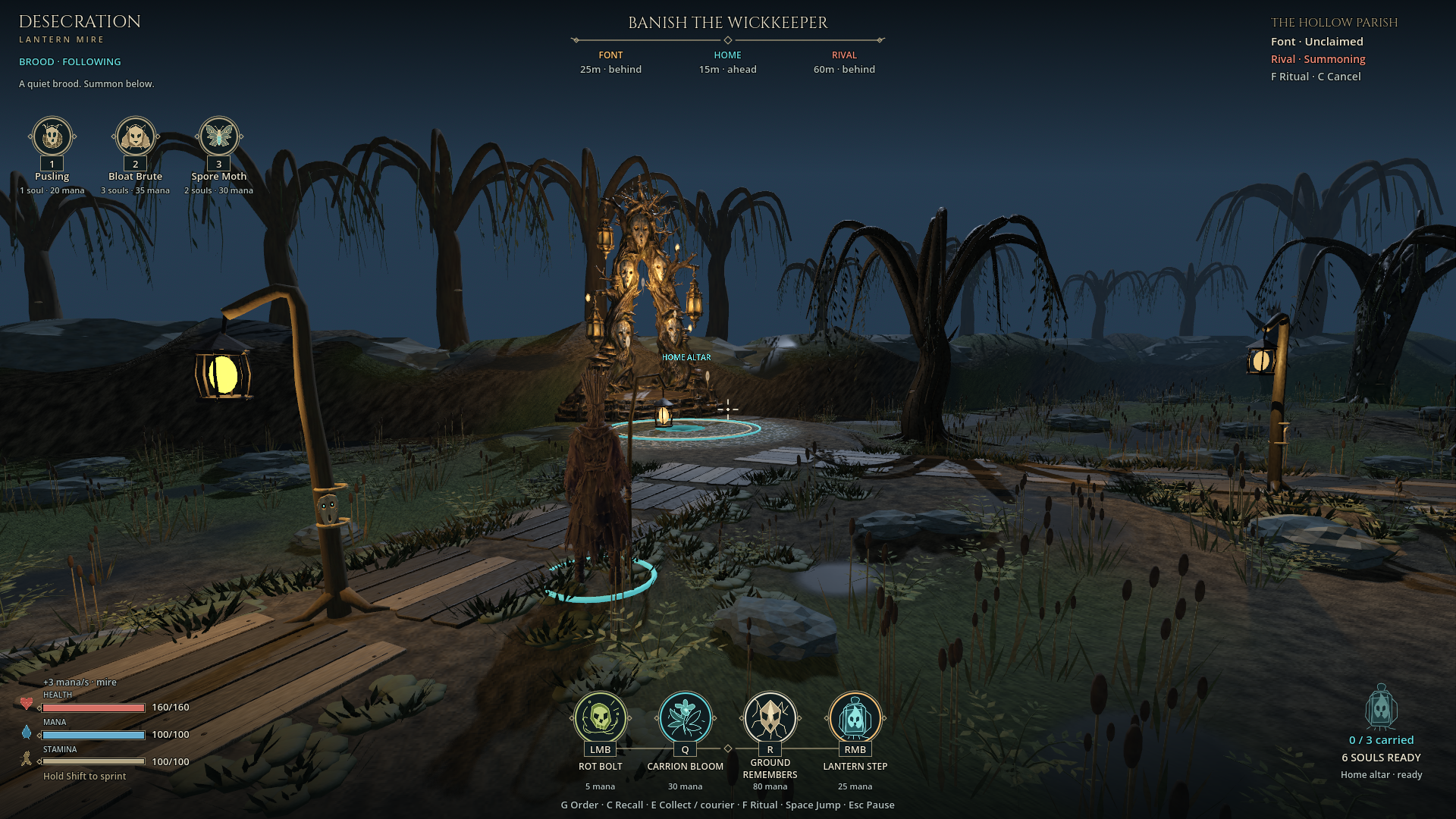
Low planting, weathered logs and mossy peat bring the ground around the home altar together.
The new god monuments gave the battlefield a stronger focal point. This smaller pass works on the ground leading to one of them: how vegetation gathers, how wood meets earth, and how the clear route stays visible as the camera moves.
A small piece of the mire
The work covers roughly twenty by twenty metres on the home approach. Seven planting centres replace some of the loose, evenly scattered clutter with connected beds of low sedge, fern, weathered logs and flat slate. A moss-and-peat colour texture gives the surrounding earth more organic variation. Two existing lanterns receive a restrained brightness adjustment.
The original terrain, planks, landmarks and playable spaces remain authoritative. Full prop footprints are checked against the paths, player start and ritual circle. The ground is still traversable, and the altar remains the clearest destination.
What Higgsfield contributed
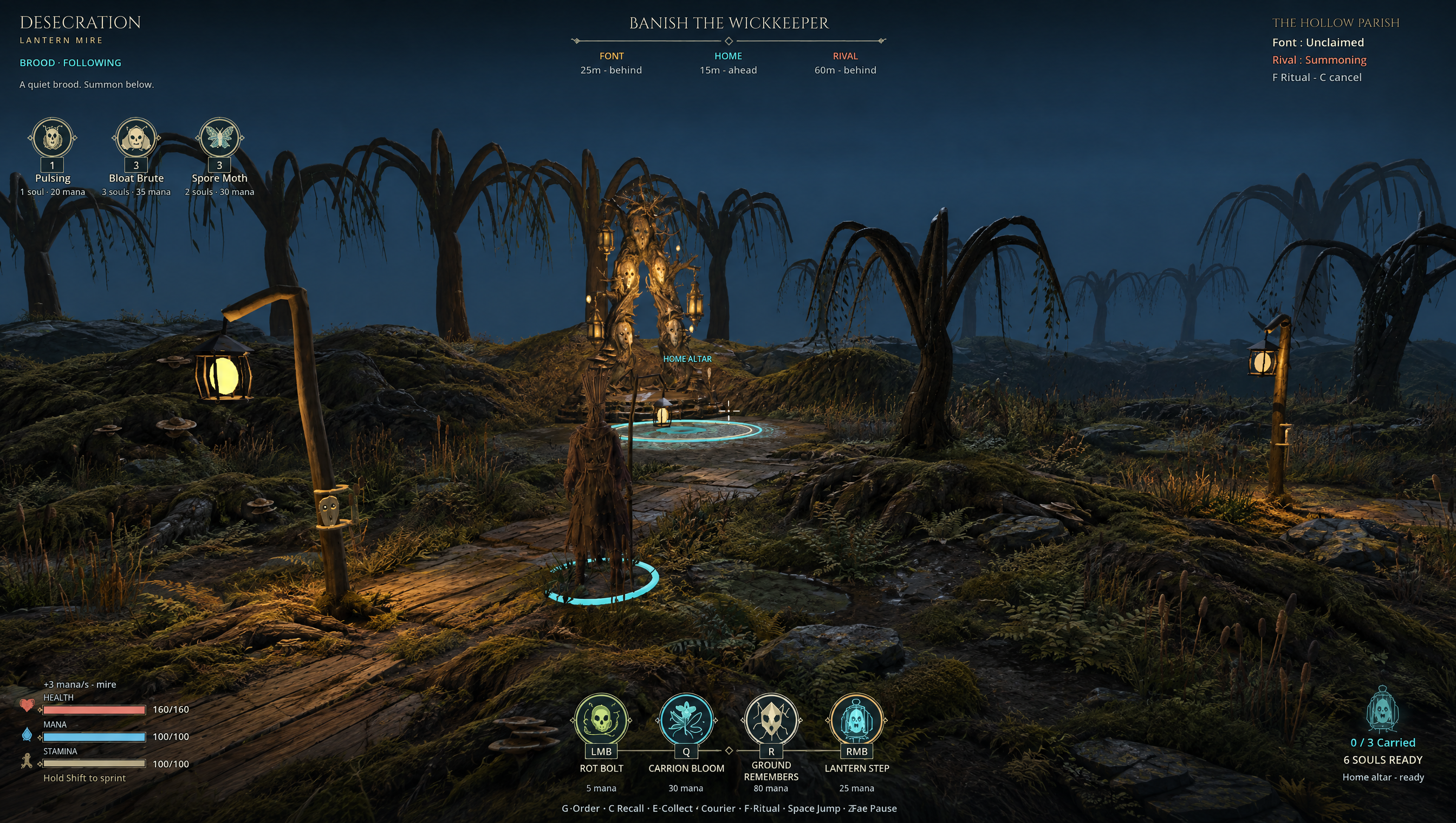
Two composition studies used the actual altar screenshot together with our original Lantern Mire painting. The selected study favoured tangled roots, olive moss and quiet dark peat. It provided a material and grouping direction; it is not a screenshot of the playable result.
Higgsfield also generated the one new 2K ground-colour map. Existing prepared log, slate and vegetation meshes supplied all geometry. Godot handles the slope alignment, protected spaces, repeated placements and lighting. Geo-Scatter was excluded as requested; there was no new Meshy generation, Blender pass or Jutsu/Astra session.
The three image jobs quoted nine Higgsfield credits. A later workspace balance changed by 20.58 credits, which does not reconcile to that quote; a per-job debit remains unconfirmed. The completed jobs and prompts are retained, with no repeat submissions or software purchase.
Room to see and move
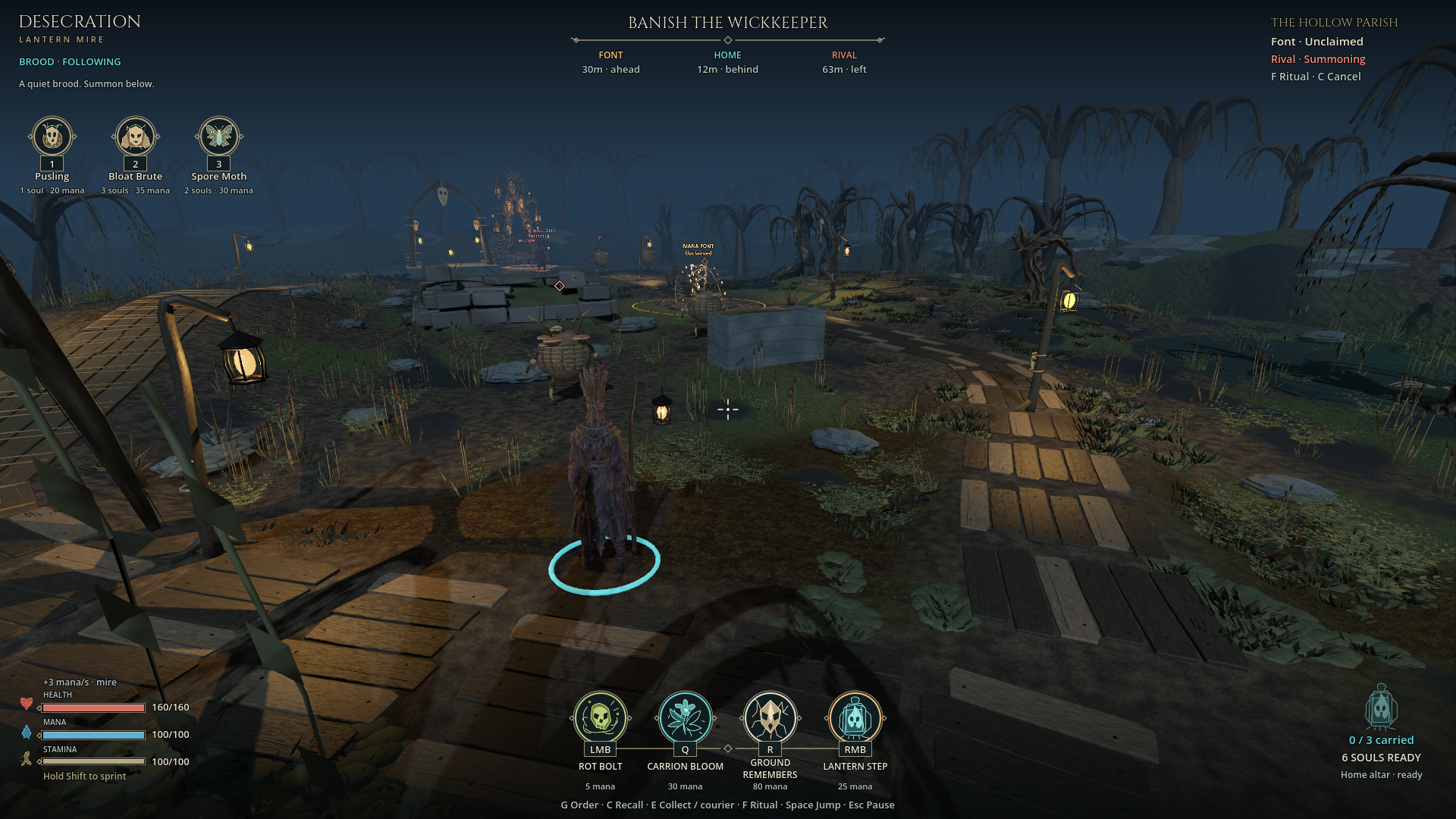
The updated ground is deliberately low. Both routes retain clear corridors, the actual ritual space is unobstructed, and all four gods remain readable under the local lighting. Existing physics and navigation checks pass. Pause and restart preserve normal foliage behaviour, and the area rebuilds with the same placements.
Scenery outside the area keeps the same transforms and colours in the exact old and new packs. The new app also passes the native two-window network checks across all four god pairings. It remains a separate playtest, with a matching build required on both peers.
The detail has a cost
Four matched one-minute native samples put the same sixteen-creature combat fixture in the home view. Every sample completed 120 bolts and fourteen area casts with the soul ledger intact. Average frame time rose from 12.69 to 13.53 milliseconds: about 0.84 milliseconds, or 6.6 percent, in this view. Movement trajectories varied slightly, so this is a repeated workload comparison rather than a bit-identical replay.
Reported graphics memory rose by about 5.5 MiB, and the playable pack grew by about 5.2 MiB. The arena adds eighteen spatial batches and a net 269 scenery instances, sharing the existing meshes and materials. No extra shadow light or per-frame scenery loop was introduced.
The checks ran on the local M5 Mac at a 1920 × 1080 render resolution. Individual frame spikes remained in both builds; the largest new-build sample reached 53.4 milliseconds. This area does not resolve the wider performance work, and its cost is a reason to measure each future expansion.
A useful step toward the painting
The playable result has more cohesive low planting and ground colour. It still has less sculpted depth than the concept, particularly in the banks and root masses. Those larger shapes would need their own terrain and combat-readability decision.
The repeatable workflow is now small enough to reuse: capture an actual view, make a tightly anchored study, compose one area with the current kit, then compare motion and busy combat before expanding. From the first concept submission to the verified native app took about forty minutes, including local revisions and checks; the concept pair was observed complete after about one hundred seconds. Publication and media preparation followed separately.