The storm beneath.
Veyra and the Copper Pilgrim bring jointed stone, copper conductors and a storm that can pull a formation together before striking it.
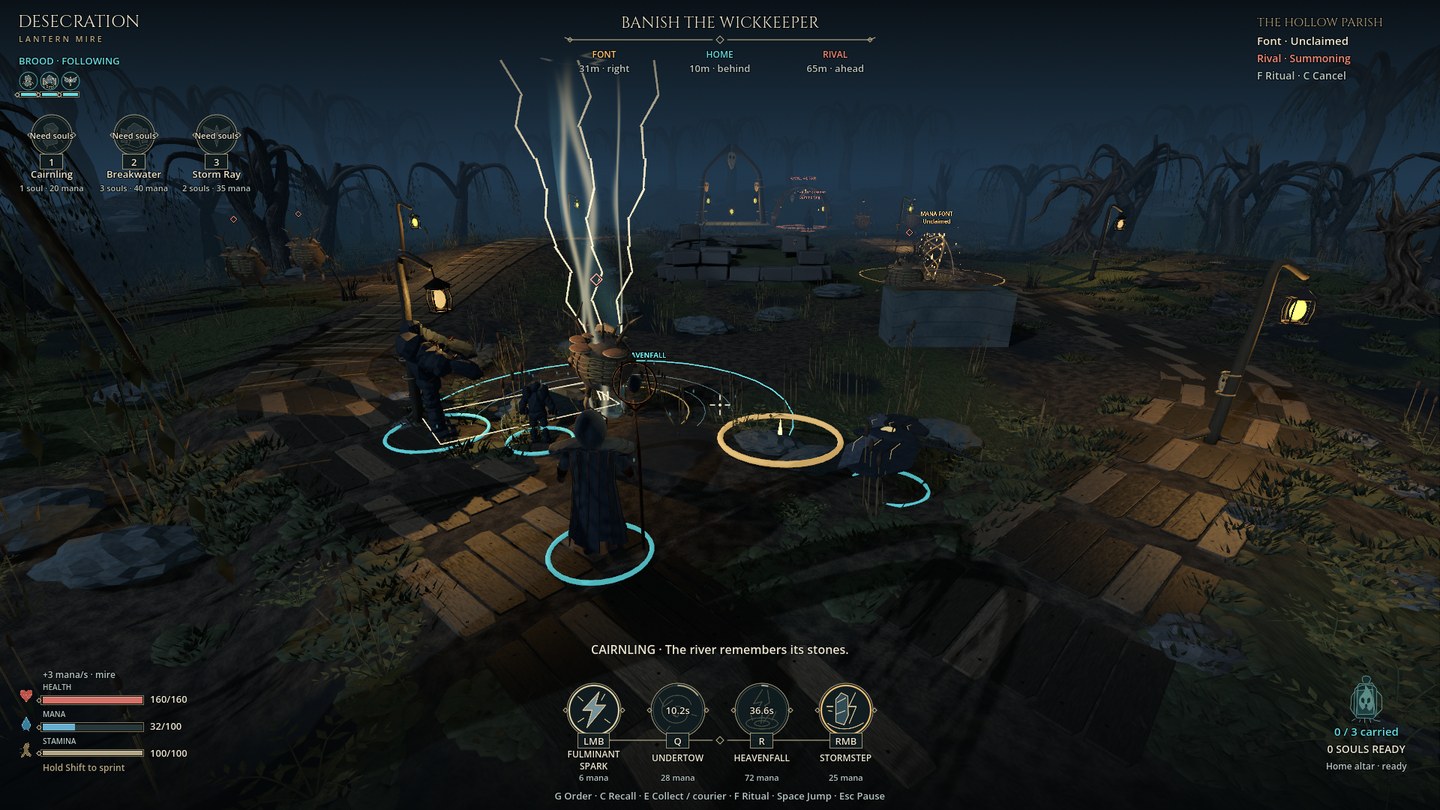
The next pairing in Shaun's sequence is Drowned Tempest. It trades the Crimson Vow's healing and health payments for physical displacement, a short electrical arc and a clearly warned storm strike.
Pull, warn, strike
Fulminant Spark is a visible dart: eighteen damage to the first enemy, then one eight-damage arc to the nearest other visible enemy within three and a half metres. Both the projectile and its secondary arc respect solid cover.
Undertow draws enemies into a circle after a short warning. The pull moves their actual collision bodies, stops at walls or occupied space and caps each victim's travel at 2.25 metres. It causes no damage and keeps carried souls and existing orders intact.
Heavenfall gives a formation 1.35 seconds to leave its marked circle. One strike deals more damage in the small inner ring, then fades. Stormstep retains the familiar paid teleport with its own pressure wake. The opponent pays the same mana costs.
Three creatures with different commitments
The Cairnling is Veyra's small stone carrier. A successful strike can briefly hinder an enemy, and it handles the faction's soul courier and altar sacrifice duties. Breakwater is the heavy: it prepares a narrow four-metre forward wave. A sideways move escapes the strip; damage interrupts the preparation.
Storm Ray has broad mineral fins and a contained electrical core. It fires two small projectiles from opposite fins, a fifth of a second apart. A new command, damage, cover or lost range can cancel the second shot. Like the Moth, its low flight follows existing ground routes.
Built from the storm study
We authored the Copper Pilgrim's slate mantle, two jointed stone creatures, the Ray, Veyra's menhir shrine and a separate spell conductor in Blender. Each has original colour, grain, emission and material maps. The four actors have rigged clips; the Ray uses its own five-bone fin-and-tail rig.
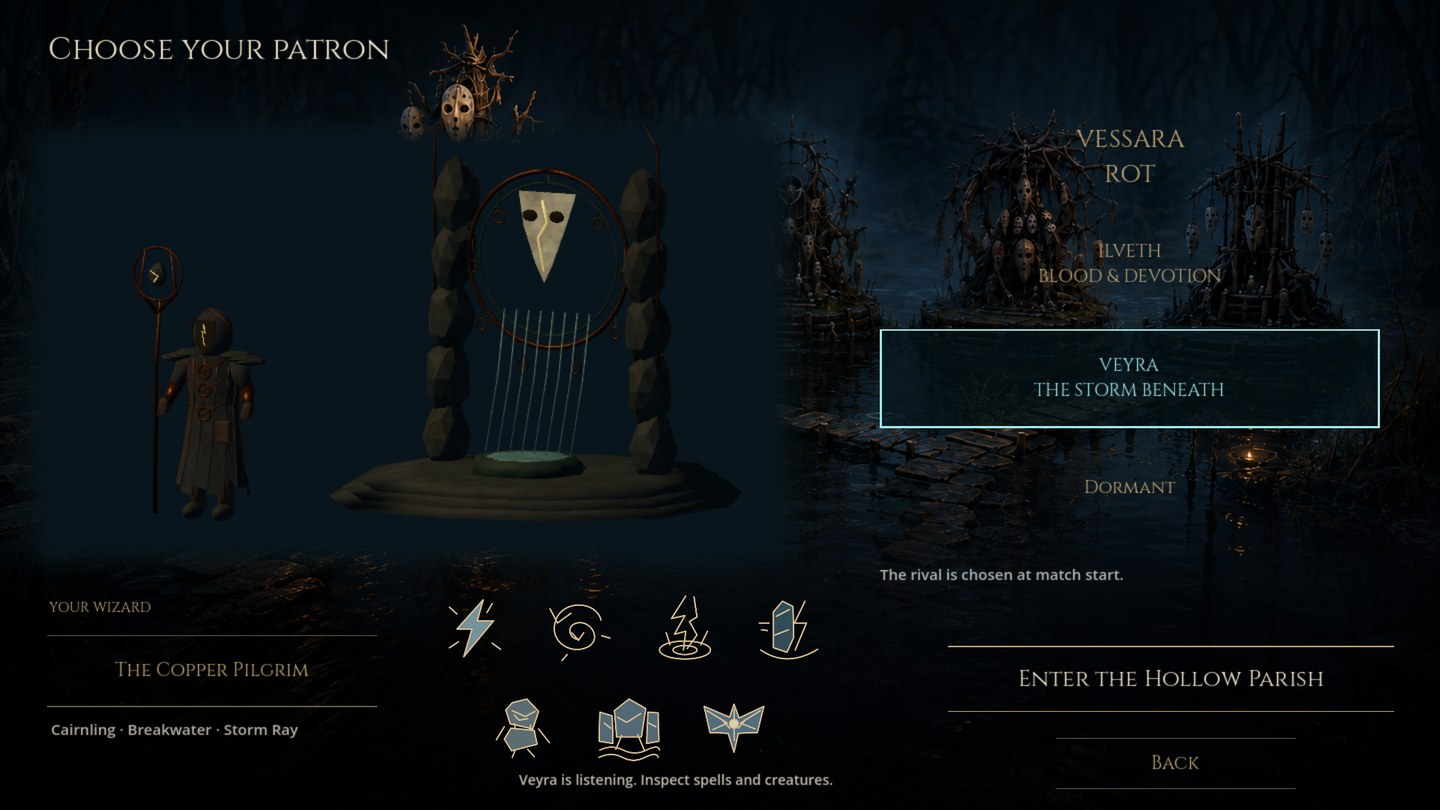
The shrine carries a pale storm mask in a copper aureole, with small falling water details. The spells use finite geometry and a contained luminous column rather than a screen-filling flash. Seven original glyphs, six synthesized sound cues and short text barks complete this first implementation. The detailed concept remains an aspiration; these are stylized game assets.
A choice on either side of the mire
Veyra now joins Vessara and Ilveth in the courtyard. Her actual wizard and shrine appear in the selection view. Four spell inspectors and three creature inspectors show their models, effects, costs and roles; the game HUD follows the selected pairing and existing remapped controls.
The main rival is chosen once when a fresh match begins. Restart preserves that pairing. All nine combinations of the three delivered patrons retain the two-side, eighteen-soul economy and the existing altar victory rules.
A saved checkpoint, then the wrong reflection
Source and exported-game checks cover payment, contact limits, cover, physical movement, carried souls, interruptions, all new matchups, selection and restart. Earlier combat, camps, recovery, controls and menu checks were rerun. The Mac build, original sources and preceding checkpoint are preserved.
Computer use remained unavailable while the Mac was locked. Native rendered fixtures, engine-input checks and standalone executable startup are recorded separately. Human art, audio and balance judgement, physical Intel and Windows execution, and notarization remain unverified.
Next is Vorr's Wrong Reflection treatment: the Misbound, Knotling, Fracture Beast and Rift Eye. It will be a separate faction built around dark glass and predictable disruptions.