The same sparks, less work.
Animated effects update more efficiently. Sampled combat frame time falls by roughly 5–9%, with the same assets and quality settings; heavy-spell results remain mixed.
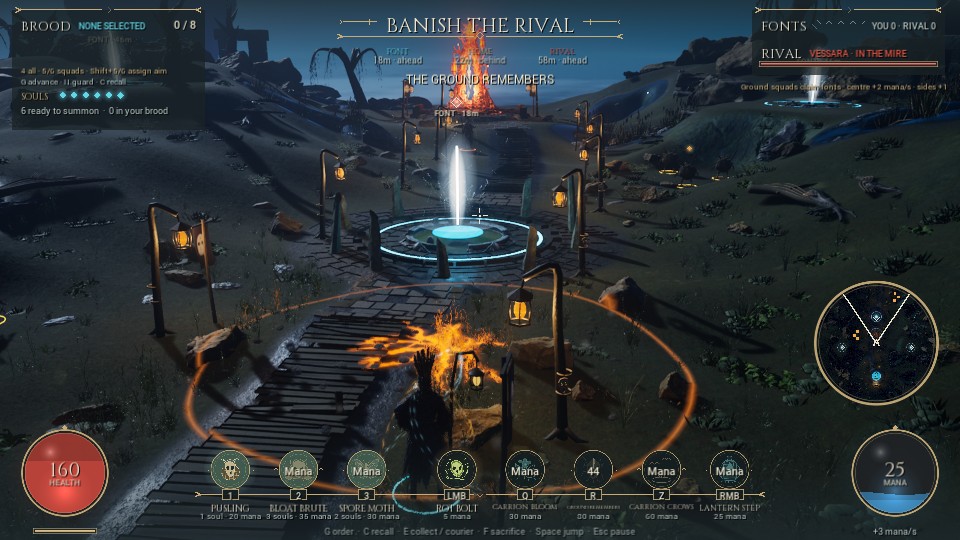
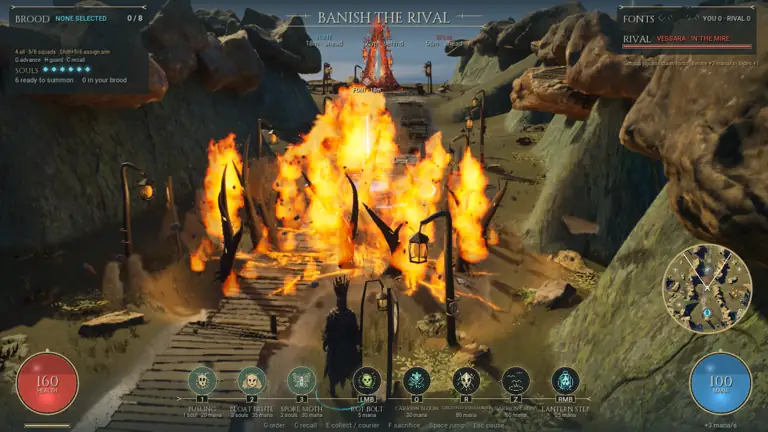
The casting wisps and eruptions help explain what a wizard is doing. Improving performance should preserve that information. This pass changes how the game sends moving effect instances to the renderer, while retaining their shapes, colours, density and timing.
Send what moved
The game was rebuilding the rendering representation of several instanced effects every frame. Unreal already tracks their changed transforms and colours. Using those incremental updates removes the redundant rebuild for sprite pools, altar spirits, spell debris, motes and flock poses.
No meshes, textures, animations or configuration assets changed. Particle counts, lifetimes, lighting, shadows and resolution settings remain the same. A diagnostic switch retains the old update path so both approaches can be measured in the same app.
A useful gain, with boundaries
On this Apple M5 at High, 1280 × 720 and full internal resolution, combat comparisons showed roughly 5–9% lower average frame time. In the repeated Mire comparison, the average moved from about 31.3 to 34.3 FPS. Both maps showed lower combat frame time in the final fixed-step samples too.
Heavy-spell results were mixed: Mire improved in these samples, while Passes took about 7–9% longer. Fixing the simulation step aligned the number of frames, but did not produce identical AI battles or effect populations. These are observed workloads, not a universal speedup or a 60 FPS claim.
The old benchmark also took screenshots during measurement and sometimes labelled High as Balanced after startup reapplied the preset. Those errors are corrected. Removing screenshot stalls improves the measurement; it does not count as a gameplay optimisation.
The spells still need to read
A matched 360-frame Vessara sequence compares the old and new update paths. The pictures remain close, with small temporal and shadow differences rather than pixel-identical output. The final package adds another 1,440 staged casting frames across all four wizards, including the daylight Passes.
The exact final app passed 1,418 assertions covering gameplay rules, campaign and skirmish input, and two actual local host/guest sessions. Casting preparation, release and caster auras still appear on both peers. Previous playtests remain preserved.
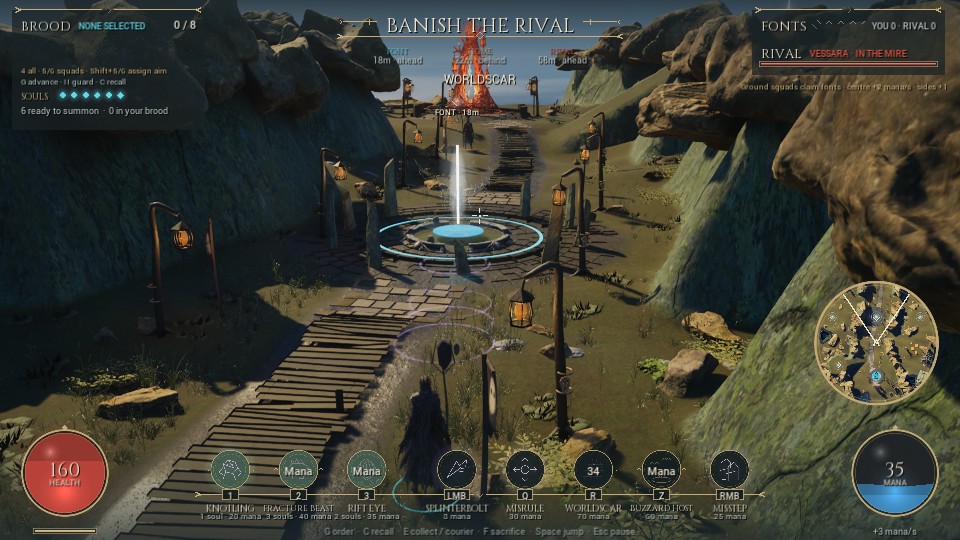
4 October follow-up: less work before the eruption
A second checked build batches 437 Ground Remembers instance additions into four calls. It also skips updates to decal-replaced fissure meshes and stops constructing four ancestral meshes that were already permanently hidden. Visible effects, lighting, assets, cast timing and damage remain unchanged.
In a fixed-camera fixture with unit movement disabled, repeated setup fell from 0.355 to 0.284 ms in Passes and from 0.418 to 0.299 ms in Mire: about 20–29% less setup time, but only 0.07–0.12 ms saved. Overall spell frame time was effectively unchanged. This is a modest CPU improvement, not another large FPS gain.
The isolated fixture did not reproduce the earlier heavy-battle slowdown. Randomized flame and smoke samples still vary, so it is not deterministic replay. The new app passed 1,418 rules, input and local-peer assertions, plus 720 staged casting frames and ten fixed-camera images. A distance-field lighting experiment showed no useful gain and was removed.
Where the remaining time goes
The game is still largely limited by GPU work in the measured scenes. Lighting is the largest identified cost, but simply disabling it would change the world. The next performance pass should compare more selective lighting and shadow changes against the same views.
Large spell fights and the destructible crossing also need closer profiling. This iteration leaves their gameplay and navigation rules intact. Human play acceptance, other machines and remote Internet multiplayer are still separate checks.
4 October — a 60 FPS target, with limits
The shared settings now expose 60, 90, 120 and Unlimited frame limits. Existing preferences and the original 60 FPS default are preserved. A new optional Adaptive 60+ preset retains Balanced lighting, shadows and effects while adjusting internal resolution between 67% and 100%; the HUD remains at output resolution. The name describes a target, not a guarantee.
On the Apple M5 at 1280 × 720, the final Mac package averaged 67–84 FPS using the existing Performance preset. Its six measured phases all had 95th-percentile frame times within the 60 FPS budget. Some individual frames still missed it. This is existing lower-cost lighting and shading made usable above the old cap, not a new full-quality speedup.
Adaptive retained the richer Balanced lighting but averaged 56–64 FPS in the final Mire sample. Earlier two-map comparisons improved traversal and crowded combat modestly, while major-spell results were mixed. A large transient slowdown affected both presets in another pair of runs and remains recorded. Sustained 60 FPS with Balanced or High presentation is still unfinished.
The exact final app passed 1,474 rule, native-input, settings and local host/guest checks. Six staged casting sequences contain 2,160 frames across both maps and three presets. Warning rings, casting light and eruption cues remain readable; Adaptive softens fine detail, while Performance changes fog and shadow presentation. The images above remain labelled captures from earlier builds. The new full-resolution comparisons are retained with the local playtest.
For the measured above-60 setup, choose 1280 × 720, Performance, and a 90 or 120 FPS frame limit. High remains unchanged. Further work must reduce heavy-scene GPU cost without losing atmosphere. Windows is deferred.
4 October — let the stone keep its shadow
Changing a patron model left the stone altar marked as movable. It now returns to static mobility after the swap, allowing its local-light shadows to be cached. Tutorial repositioning and animated portals still work. No lighting, fog, mesh detail, effect or resolution setting was reduced.
Repeated fixed-camera tests in the Mac package measured a small saving: 17.636 to 17.519 ms per spell frame, about 0.12 ms. Live battles showed larger differences, but their AI outcomes varied; those differences are not a controlled speedup claim. Balanced combat still does not sustain 60 FPS everywhere. Earlier editor measurements also exposed substantial competing desktop GPU work, which subsided during packaged tests.
The exact app passed 1,567 gameplay, native-input, altar-camera and local multiplayer checks. Another 1,440 captured frames support two matched comparison films retained with the local playtest. Existing public images above retain their original build labels. Further experimental lighting changes were not included.
4 October — spend detail where it shows
Six dense rock meshes now retain their original close geometry and collision, with lighter distant versions. Lighting, textures, effects and resolution stay unchanged. Two shader experiments were rejected.
Sixteen packaged comparisons suggest a small saving: the repeated spell test averaged about 0.47 ms faster, roughly 2%, on both maps. Competing desktop GPU work and long frames remain; this is not a locked-60 result. The exact app passed 1,422 gameplay, native-input and local multiplayer checks. Another 2,280 staged frames support three local comparison films; sampled motion retains silhouettes and spell cues. Public images above remain labelled by their original builds. Next: repair repeated campaign dialogue, then audition more mystical god voices.