Voices at the threshold.
Ilveth, Veyra and Vorr gain timed staff rituals. The gods now speak, wait for a choice, and hear the wizard answer.
The altar camera gave the audience a place. This iteration gives it a voice. The conversation now has room for a greeting, a question spoken back, and an answer that belongs to the god you approached. Across the battlefield, the other three wizards also prepare their largest spells with a visible staff gesture.
4 October: casting the gods
Twelve new audition performances explore seductive Vessara, a slow ancient Ilveth, airy and incisive Veyra, and fractured, volatile Vorr. Each god has three candidates reading the same greeting. The local Voice Chamber separates voice choice from reverb, resonance, echoes and layered doubles, with dry playback, a current-game reference and portable settings.
Qwen and Maya generated the candidates. All twelve passed word checks; Ilveth received slower, pitch-preserving pacing and pauses, checked again afterward. The chamber includes the retained recordings and changes no campaign audio. Source and file checks pass; browser playback and human acting approval remain open. The media above show the earlier campaign voices.
4 October: one conversation, once
Finishing or skipping a narrated campaign line now advances once. Choices stay in the cinematic frame, without bringing back the old prose panel. Offer and oath terms remain available; leaving during a spoken acceptance still cancels it.
The separate Mac build passed 1,823 dialogue, rules and native-input assertions. All four patrons retain cinematic choices; repeated lines and segmented recordings have progression checks. A new local film retains game audio. The media above document the earlier voice build. Mystical voice treatments are the next listening pass.
Let the god finish
The first shot establishes the altar. When the greeting ends, the responses appear. Choosing a question hides them again and cuts to the wizard, who speaks before the god replies. Reverse angles cut cleanly; the camera no longer travels through the court between speakers.
Enter or Space skips the current line. Escape leaves the audience, stops the voice and restores the exploration view. An oath remains uncommitted while its acceptance is being spoken, so leaving during that line cancels the pending choice. Equipment and other informational screens stay immediately usable.
Four temperaments, one uneasy bargain
Vessara is warm enough to be unsettling. Ilveth speaks of shared burdens and obligations. Veyra values competence and has little patience for enthusiasm. Vorr insists that refusal must remain possible. The dialogue gives each god motives, disagreements and a changing response to the campaign.
The game now contains 259 recorded English lines—roughly half an hour of speech—for the patrons, wizard, ghost, Pell and rival keepers. Higgsfield’s existing voice presets produced the performances; the accepted recordings ship with the game and play without an online speech service. Subtitles and Voice Volume remain available in the shared settings.
Generated takes needed editing and verification. Unwanted inserted speech was removed only where the intended words remained intact; ambiguous instructions received replacement takes. Every final line was transcribed again and checked against its script. Acting and pacing still deserve a human listening pass.
The other staffs answer
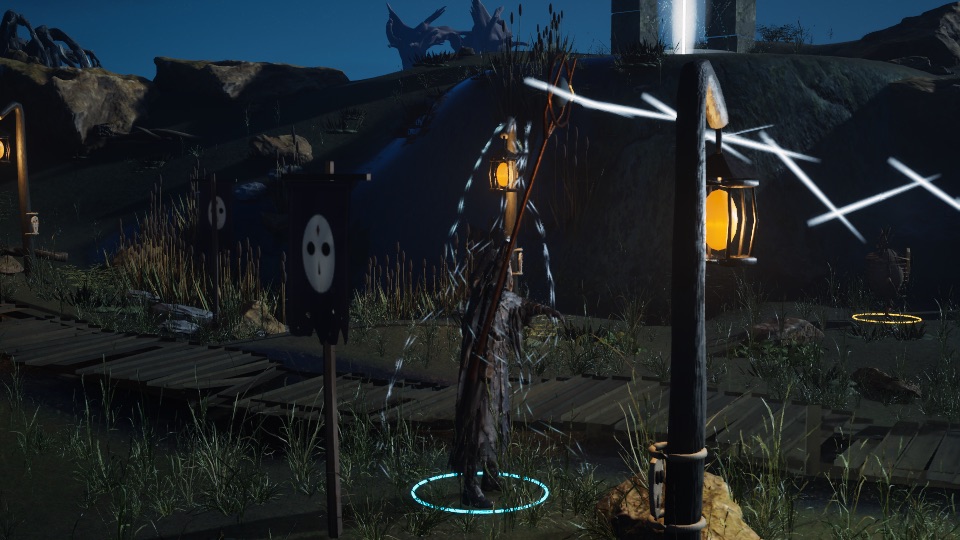
Ilveth, Veyra and Vorr now have nine new Blender-authored casting clips between them: an extended staff circle, a raised staff planted at release, and an overhead gesture. Their preparation lasts between 0.7 and 1.2 seconds, depending on the spell. Thinner blood, storm and violet trails keep the movement visible.
The cost is paid once when preparation begins. Feet remain planted until release, the aim is checked again, and death interrupts the spell. Borrowed campaign gifts retain their source’s timing and colour while using the current wizard’s body. Both players see preparation and release in the local multiplayer checks.
A separate build, with receipts
The final Mac app passed 2,023 assertions covering spell rules, all recordings, dialogue input, camera restoration, shared settings and local host/guest play. Six staged casting captures retain 2,160 frames. Both six-battle loyal and switching routes completed without retries on the combat-equivalent preceding candidate; the final revision only corrected unvoiced information-screen timing.
The previous playtests remain intact. These checks establish behaviour and recorded content, not a claim of finished AAA animation or human voice-acting approval. Lip sync, existing locomotion limitations, remote multiplayer and performance work remain separate.